Deep Dive: Adding a Custom Contract (research notes, not a working guide)
Status: broken. Do not use this as-is. The mechanism below was confirmed working end to end — menu entry, accept flow, teleport-out, spawn/destroy/reward — in a single fresh-start test. But the script that produces that result permanently breaks the lua bridge (the external mod-loader layer itself, not just the in-game Lua VM) when the save being loaded spawns the player directly inside the PMC HQ. The only known fix once this happens is to remove the script from
scripts/OnLoad/entirely. Root cause not found yet. This page is a record of what’s been confirmed, what’s still broken, and what to try next — not a drop-in recipe.
The goal
Get a custom mission into the world’s contract pool and make it startable the same way every real contract is: by talking to a PMC HQ starter (Fiona/PmcBoss) and picking it from her briefing menu. On purpose, the mission itself is as trivial as possible — destroy 3 cars spawned nearby, one flat reward — so the interesting part is the plumbing, not the gameplay. The intent is a minimal, honest skeleton other mods can build a real contract from, once it actually works.
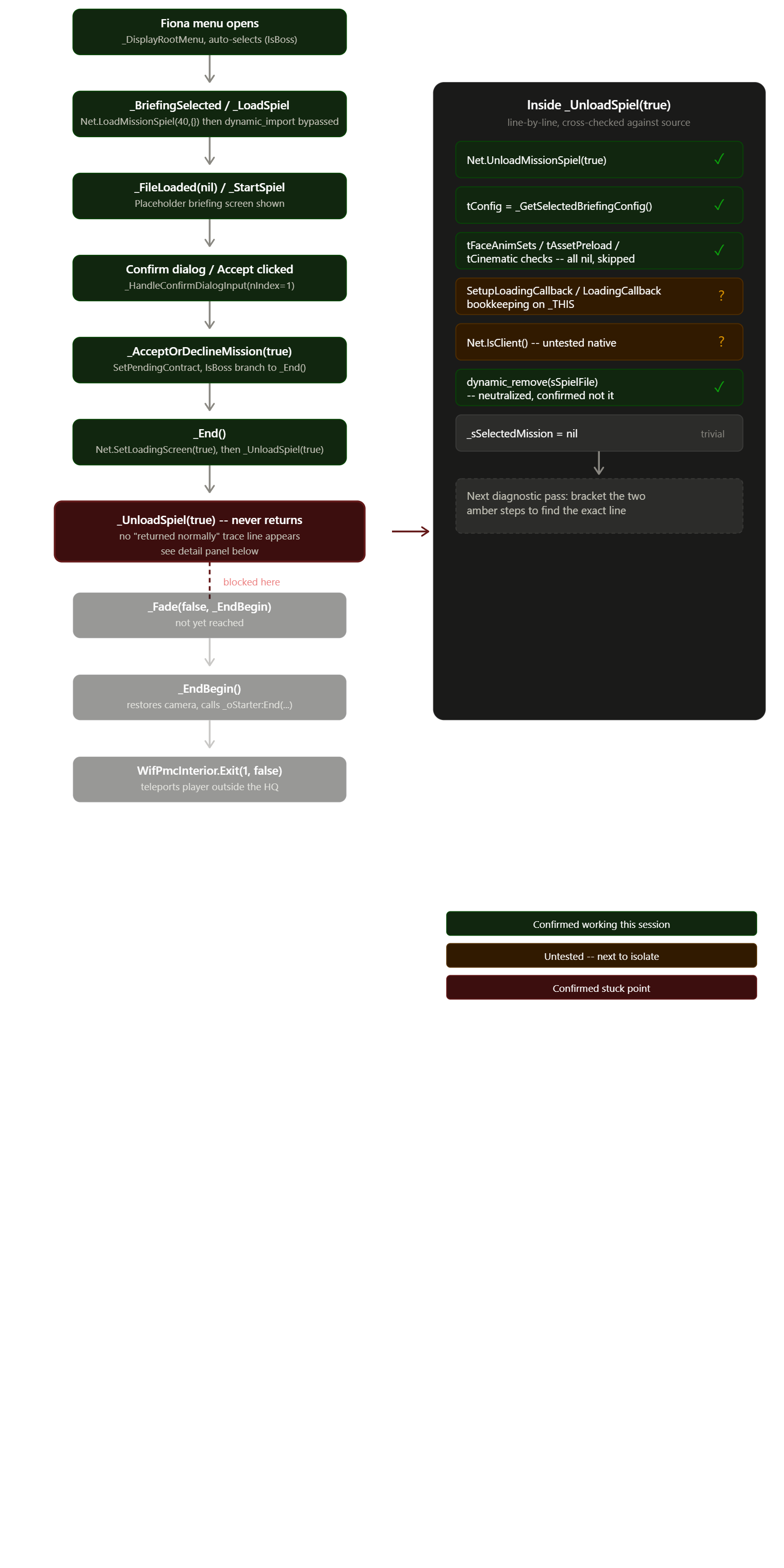
This diagram is a mid-investigation snapshot, not the final state — it was drawn while still hunting for the exact line inside _UnloadSpiel that wasn’t returning, before GetSpielFileName’s real bug (the string.format("%02d", nil) crash on a non-conforming mission ID, covered below) was actually found. The “untested”/”stuck point” labels on _UnloadSpiel are now out of date — that call was fully resolved and the flow was confirmed to complete end to end past this point. Still useful for the overall shape of the accept sequence and as a record of the diagnostic process, just don’t read the coloring on the right-hand panel as current.
The mechanism that’s confirmed working
Registering the mission
WifMissionData.tMissionData (vz/wifmissiondata.lua) is the master mission registry, keyed by mission ID string. A custom OnLoad script can add its own entry directly:
WifMissionData.tMissionData.CustomTest001 = {
  sFactionId = "Pmc",
  sStarter = "PmcBoss",   -- Fiona
  bRepeatable = false,
  fOnActivate = CustomTest001_OnActivate,
  bContract = true,       -- see below, this has to be set by hand
}
bContract matters more than it looks like it should. In every real mission entry it’s absent — it gets computed once, for every mission, by WifMissionData.Init():
for sMissionId, tMissionConfig in pairs(tMissionData) do
  local sFaction, bMissionType, nMissionNum = MrxUtil.ExplodeMissionName(sMissionId)
  tMissionConfig.bContract = bMissionType
end
That Init() pass already ran, once, before any OnLoad script’s custom entry exists — so a custom mission has to set bContract = true itself, or WifMissionData.IsMissionAContract() returns false for it. That function gates whether accepting the mission calls _oStarter:SetPendingContract(...), which is what later tells WifPmcInterior.Exit() where to actually send the player on the way out. Skip this and the accept flow completes, but you’re left standing in the HQ interior with nowhere to go — the first symptom hit while building this.
Getting it into the starter’s menu
WifMissionFlow.UnlockMission(sMissionName, tSaveData, bBlockingSequence) (resident/mrxmissionflow.lua) is the real entry point — not something to build by hand. It looks up the registry entry, builds an MrxTask container + mission instance, auto-populates tMissionConfig.tRewards from MrxRewardData.GetRewards(sMissionName) (a custom MrxRewardData._tRewards.CustomTest001 entry is picked up automatically, no extra work needed), wires wager win/loss settlement into the task’s own tOnComplete/tOnCancel lists, and finally calls MrxStarterManager.RequestStarter(sStarter):AddBriefing( sMissionName, sMissionTitle) — confirmed to be exactly what makes the mission appear in Fiona’s menu. Triggering it from a live game (a console/dev command, or a one-shot OnLoad hook) is enough:
import("WifMissionFlow")
WifMissionFlow.UnlockMission("CustomTest001")
Skipping MrxTaskContract entirely
A real contract sets sModuleName and lets the engine dynamic_import() its own module — that’s how it becomes an instance of MrxTaskContract instead of a bare MrxTask, which is where the free completion fanfare, cash-reward math, and wager-settlement UI come from. This mod does not do that (see the hard rule below), so it stays a bare MrxTask, driven by config callbacks instead of a subclass:
fOnActivate = CustomTest001_OnActivate,
Two things about this that aren’t obvious until you hit them:
- The callback is called with zero arguments.
MrxTask._IssueStateChangeCallbacksdoesif fCallback then fCallback() end— noself, nothing. The activation handler has to look up its own live instance a different way:WifMissionFlow._tActiveMissions.CustomTest001.oMission, confirmed non-localand populated synchronously byUnlockMission, well before activation ever fires. - No
MrxTaskContractmeans no automatic reward payout, either. This mod grants cash manually withMrxPmc.AddCashQty(5000, false, "[Generic.Wagers]")inside its own completion check, rather than relying onMrxTaskContract.Complete2’s reward-ledger logic (which isn’t reachable without inheriting it).
tStartLocations can be a literal coordinate, not just a named marker
Every real mission’s tStartLocations is a list of string names — placed level markers, e.g. {"OilCon005_Startpoint_01", "OilCon005_Startpoint_02"} — resolved to a position via Pg.GetGuidByName/Object.GetPosition. A custom mission has no such marker placed in the compiled level. Reading MrxUtil.TeleportHeroesToLocations directly settles it, though — it explicitly branches on type(vLocation), and a plain array table is a supported case, not just strings/userdata:
elseif sType == "table" then
  nX = vLocation[1]
  nY = vLocation[2]
  nZ = vLocation[3]
  nYaw = vLocation[4] or 0
end
So tStartLocations = { {2776.8684, -13.8681, -873.5605} } on the mission config is a legitimate way to pin the post-accept teleport to a known, open location, without needing a real placed marker. This part is source-confirmed but not yet independently re-verified live — see below.
Hard rule #1: never call — or wrap — dynamic_import/dynamic_remove
These two are native functions with no decompiled Lua body, and they are the single most dangerous thing touched in this whole investigation. Confirmed by two separate, real game crashes with an identical signature (AV READ target=00000029, EIP=0059C82A):
- Calling
dynamic_importwith a name that was never a real compiled asset crashes outright. - Wrapping/interposing
dynamic_import— even passively, even calling straight through to the real thing with no logic changed — crashes on a real, valid asset name (Spiel_MinorContract_Pmc31_Jennifer, from the already-shippedPmcCon031). It’s sensitive to its immediate caller’s Lua environment, not just its arguments — adding one extra Lua stack frame between it and its real caller is enough to break it.
The practical consequence for this mod: it must never set sModuleName (which would make the engine call dynamic_import on a name that was never compiled), and it must never wrap dynamic_import itself for any reason, even diagnostically. Every workaround below is built around avoiding the call entirely, never intercepting it.
Hard rule #2: never write return fOriginal(...) in a wrapper
This one cost a real crash on an already-shipped mission (PmcCon031) before it was understood. Wrapping any function like this:
SomeModule.SomeFunction = function(...)
  fOriginal(...)
end
…compiles the call as a Lua tail call — the current stack frame is replaced rather than a new one pushed. This engine’s own module system uses getfenv(n) in places (walking n stack levels to find a module’s environment), and a collapsed frame throws off that level-counting. The exact, reproducible symptom: :1: no function environment for tail call at level 2, thrown from inside the engine’s own briefing code, not this mod’s.
The fix, applied to every wrapper in this codebase from here on: never return fOriginal(...). If the return value is discarded by every real caller (checked case by case), call it as a plain statement. If the return value is actually used (as with GetSpielFileName, below), capture it in a local and return that local on a separate line — a genuine second statement, not a tail call:
local sResult = fOriginalGetSpielFileName(sMissionName)
return sResult
Working around the briefing flow’s assumption of a real spiel asset
Even with sModuleName skipped, selecting any mission from Fiona’s menu still runs through mrxbriefing.lua’s shared briefing flow, and two points in it assume every mission has a real, compiled “spiel” (the briefing conversation/cutscene asset) on disk.
_LoadSpiel — the load side
Selecting the mission calls _BriefingSelected → _LoadSpiel, which calls dynamic_import(GetSpielFileName(sMissionId), _FileLoaded). There’s no such asset for a custom mission, so this would crash exactly like the first dynamic_import test did. Fix: hijack _LoadSpiel itself (an ordinary Lua function — the native is dynamic_import, not the function that calls it, so wrapping this one is safe) and, only for CustomTest001, skip dynamic_import and call _FileLoaded(nil) directly:
if MrxBriefing._sSelectedMission == "CustomTest001" then
  if Net.IsServer() then
    Net.LoadMissionSpiel(WifMissionData.GetMissionIndexFromId(MrxBriefing._sSelectedMission), {})
  end
  MrxBriefing._FileLoaded(nil)
else
  fOriginalLoadSpiel()
end
Two things had to be confirmed by reading source, not assumed:
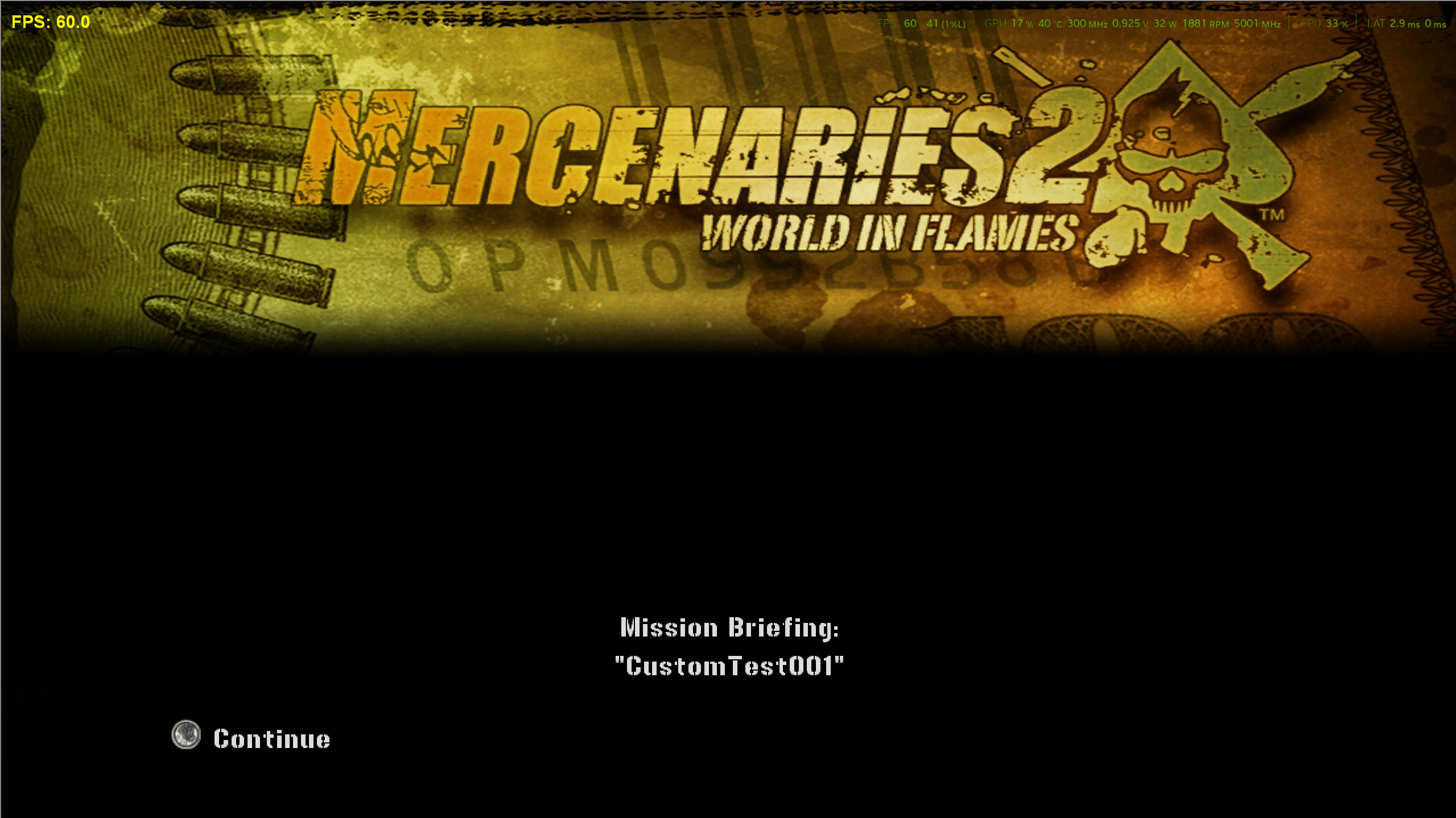
_FileLoaded(nil)doesn’t hang. Its pending-load counter starts at 0, and every block that would increment it is gated ontype(tFile) == "table"— all skipped whentFileisnil— so the one unconditionalMrxUtil.LoadingCallback(_THIS)call at the end fires_StartSpielimmediately._StartSpiel’s own_PlayCinematicalready has a generic placeholder fallback (a plain"Mission Briefing: <name>"caption) for a mission with no cinematic configured — confirmed directly from source, and confirmed live (the placeholder screen really does appear, followed by a correctly populated accept/decline dialog).- The
Net.LoadMissionSpielcall is not optional. The real_LoadSpielcalls this native beforedynamic_import, and_UnloadSpiel(below) unconditionally calls the matchingNet.UnloadMissionSpiel(bExitingBriefing)later, regardless of how the spiel was loaded. Skipping the load half while still hitting the unload half turned out not to actually be the bug (see below — the real bug was one line further down), but it’s still the correct, paired thing to do, using the same empty-actor-list shape the real code produces when there’s noWifBriefingDataentry for the mission (which is exactly this mission’s situation).
_UnloadSpiel — the real bug, and how it was actually found
Exiting the briefing after accepting calls _UnloadSpiel(true). This is where a genuine hang appeared — no crash, no log output, just a permanently frozen screen — and finding the real cause took systematically bracketing every single statement in the function with temporary logging, one at a time, rather than guessing:
Net.UnloadMissionSpiel(bExitingBriefing)— bracketed, confirmed returns normally._GetSelectedBriefingConfig()— confirmed (by readingStart(), which aliasesmrxbriefing.lua’s own_tBriefingsto literally the same table asoStarter:GetOfferedBriefings(), and sets.tConfigon every entry up front) to reliably return{}for this mission, making everyif tConfig.tXxx thenblock in the function a genuine no-op.MrxUtil.SetupLoadingCallback/MrxUtil.LoadingCallback— bracketed, confirmed both fire and return. (Also incidentally revealed that_THISin this file is literallymrxbriefing.lua’s own module environment table — itstostring()dumps every function/constant the file defines.)dynamic_remove(GetSpielFileName(sMissionId))— the last line. Neutralizingdynamic_removealone (a reasonable first guess, since nothing was everdynamic_import‘d for this mission to undo) produced zero change in the observed hang. That negative result was the actual clue: it meant execution never even reached that line.
The real bug was one call earlier, inside GetSpielFileName itself:
function GetSpielFileName(sMissionName)
  ...
  local sFaction, bContract, nNumber = MrxUtil.ExplodeMissionName(sMissionName)
  local sMissionType = bContract and "MinorContract" or "Job"
  return "Spiel_" .. sMissionType .. "_" .. sFaction .. string.format("%02d", nNumber) .. "_" .. sCharName
end
ExplodeMissionName expects the real naming convention — 3-letter faction + "Con"/"Job" + 3-digit number, e.g. PmcCon031:
local sMissionType = string.sub(sMissionName, 4, 6)  -- "CustomTest001"[4..6] = "tom"
local sMissionNum = string.sub(sMissionName, 7, 9)    -- "CustomTest001"[7..9] = "Tes"
local nMissionNum = tonumber(sMissionNum)              -- tonumber("Tes") = nil
"CustomTest001" doesn’t fit that shape at all, so nMissionNum comes back nil, and string.format("%02d", nil) throws a hard Lua error. That error gets silently swallowed somewhere above this call — no crash dump, no visible log — which is exactly what a real hang looks like from the outside. It only ever surfaced here because the _LoadSpiel bypass above never calls GetSpielFileName for this mission; _UnloadSpiel is the one and only place in the whole flow that does.
The fix is the same shape as the _LoadSpiel one — short-circuit it for this mission only, and be careful about the tail-call rule since this function’s return value is genuinely used:
MrxBriefing.GetSpielFileName = function(sMissionName)
  if sMissionName == "CustomTest001" then
    return "CustomTest001_NoSpiel"
  end
  local sResult = fOriginalGetSpielFileName(sMissionName)
  return sResult
end
Confirmed working, once, end to end
With every workaround above in place, a single fresh-game-session test completed the entire chain for the first time: Fiona’s menu shows the entry → placeholder briefing screen → correctly populated accept/decline dialog → accept → _UnloadSpiel(true) actually returns → _EndBegin → the real _oStarter:End(...) → WifPmcInterior.Exit(1, false) → teleport out → fOnActivate fires → cars spawn → destroying them fires the Event.ObjectDeath handler → cash granted → mission completes. Confirmed via live Loader.Printf tracing, not inference.
![Fiona's root menu at the PMC HQ, showing "NEW! [CustomTest001.Title]" listed alongside the real "Universal Petroleum" and "Emplaced Weapons Challenge" briefing entries.](/img/customcontract1.png)
The untranslated [CustomTest001.Title]/[CustomTest001.Terms.Summary] bracketed strings visible here and below are expected — this mod never registered real localization strings for those keys, so the game displays the raw key name instead of translated text.
![The accept/decline confirmation dialog, correctly populated from this mod's own config: "[CustomTest001.Title]", Faction: PMC, "[CustomTest001.Terms.Summary]", Rewards: $5.0K, with Accept/Decline buttons.](/img/customcontract3.png)
Two of the three spawned cars landed obscured by geometry near the default HQ exit point, which is what motivated the tStartLocations addition above — that specific fix has not yet been re-verified live, because testing was derailed by the blocker below before a second full run could happen.
The blocker: this permanently breaks the lua bridge on certain saves
After the mechanism above was confirmed working, loading a save that spawns the player directly inside the PMC HQ (rather than walking in through the door) causes the lua bridge itself — the external mod-loader layer, separate from the game’s own Lua VM — to stop functioning, silently, with no crash and no error. The game itself keeps running fine; only the bridge stops responding. It has to be removed from scripts/OnLoad/ entirely to restore it.
What’s been ruled out:
- Not the “boss starter auto-selects the first briefing entry” theory.
_DisplayRootMenudoes auto-select_tNames[1]for a boss starter (if _oStarter:IsBoss() then _BriefingSelected(_tNames[1]); return end), which looked like a promising lead — ifCustomTest001sorted first and the HQ auto-opened Fiona’s menu on load, the accept flow could fire mid-load, in a much more fragile timing window than a live player interaction. Ruled out directly: nothing auto-triggers. The game loads fine and plays normally; the player still has to walk up and talk to Fiona manually. The bridge hang happens regardless, with no interaction at all. - Not something introduced by the later cleanup pass. Reverted the script all the way back to the exact version that produced the one successful full test (full diagnostic logging, no
tStartLocations) and reloaded the same problem save. Identical failure. Whatever this is, it predates every change made after the mechanism was first confirmed working — it’s inherent to something in the core approach itself, not a regression from cleanup.
What’s still unknown: why this specific save shape (spawns inside the HQ) triggers it, why the failure is in the bridge layer specifically rather than the game’s own Lua VM, and which part of this script is actually responsible. Candidates not yet individually isolated: the hook-install guard (_G._bCustomContractTestHooked) running very early during a save load that starts inside an interior cell; whatever state WifPmcInterior/mrxbriefing.lua are in in the middle of restoring a save versus a fresh level transition; or something about registering a WifMissionData entry before the interior’s own starter setup has finished for this particular save shape.
Current script
This is what’s currently sitting in scripts/OnLoad/CustomContractTest.lua — the version that produced the one successful full run above, and also the version confirmed to still trigger the bridge-breaking bug. Included here as the record of where this investigation currently stands, not as something to use:
import("WifMissionData")
import("MrxRewardData")
import("WifMissionFlow")
import("MrxPmc")
import("MrxBriefing")
import("MrxUtil")

if not _G._bCustomContractTestHooked then
  _G._bCustomContractTestHooked = true

  local fOriginalLoadSpiel = MrxBriefing._LoadSpiel
  MrxBriefing._LoadSpiel = function()
    if MrxBriefing._sSelectedMission == "CustomTest001" then
      if Net.IsServer() then
        local nIndex = WifMissionData.GetMissionIndexFromId(MrxBriefing._sSelectedMission)
        Net.LoadMissionSpiel(nIndex, {})
      end
      MrxBriefing._FileLoaded(nil)
    else
      fOriginalLoadSpiel()
    end
  end

  local fOriginalUnloadSpiel = MrxBriefing._UnloadSpiel
  MrxBriefing._UnloadSpiel = function(bExitingBriefing)
    if MrxBriefing._sSelectedMission == "CustomTest001" then
      local fOriginalDynamicRemove = dynamic_remove
      dynamic_remove = function(sName) end

      local fOriginalGetSpielFileName = MrxBriefing.GetSpielFileName
      MrxBriefing.GetSpielFileName = function(sMissionName)
        if sMissionName == "CustomTest001" then
          return "CustomTest001_NoSpiel"
        end
        local sResult = fOriginalGetSpielFileName(sMissionName)
        return sResult
      end

      fOriginalUnloadSpiel(bExitingBriefing)

      dynamic_remove = fOriginalDynamicRemove
      MrxBriefing.GetSpielFileName = fOriginalGetSpielFileName
    else
      fOriginalUnloadSpiel(bExitingBriefing)
    end
  end
end

local function CustomTest001_OnActivate()
  local oMission = WifMissionFlow._tActiveMissions.CustomTest001.oMission
  local nCarsRemaining = 0

  local uChar = Player.GetLocalCharacter()
  local x, y, z = Object.GetPosition(uChar)

  local tCarOffsets = { {5, 0, 0}, {-5, 0, 0}, {0, 0, 5} }
  for i, tOffset in ipairs(tCarOffsets) do
    local uCar = Pg.Spawn("Veyron", x + tOffset[1], y + tOffset[2], z + tOffset[3])
    if uCar then
      nCarsRemaining = nCarsRemaining + 1
      oMission:_CreateEvent(Event.ObjectDeath, {uCar}, function()
        nCarsRemaining = nCarsRemaining - 1
        if nCarsRemaining <= 0 then
          MrxPmc.AddCashQty(5000, false, "[Generic.Wagers]")
          oMission:Complete()
        end
      end, {})
    end
  end
end

WifMissionData.tMissionData.CustomTest001 = WifMissionData.tMissionData.CustomTest001 or {
  sFactionId = "Pmc",
  sStarter = "PmcBoss",
  bRepeatable = false,
  fOnActivate = CustomTest001_OnActivate,
  bContract = true,
}

MrxRewardData._tRewards.CustomTest001 = MrxRewardData._tRewards.CustomTest001 or {
  nCash = 5000,
}
(Trimmed of the Loader.Printf diagnostic trace lines used while debugging, for readability here — the deployed copy still has them, since they’re what made every finding above possible to confirm rather than guess at.)
Open questions / where to pick this up
- Root cause of the bridge-breaking bug — not found. The next step is almost certainly to bisect by removing pieces of this script (the hook-install block, the
WifMissionDataregistration, theMrxRewardDataregistration) one at a time against the same problem save, rather than reasoning about it further without new data. - Whether the
tStartLocationsfix actually resolves the obscured-car spawn issue — not re-verified. Source-confirmed as a valid mechanism, but the live test that would prove it never happened. - Whether this reproduces on any save that starts inside an interior cell, or specifically the PMC HQ — untested. Worth checking against a save that starts inside a different interior, if one exists.
- Whether the hook-install guard (
_G._bCustomContractTestHooked) surviving across a save load (as opposed to a fresh process start) plays any role — plausible given how OnLoad script re-execution and global state were shown earlier in this investigation to persist across level reloads within the same running process, but not specifically tested against the bridge-breaking bug.
General lessons, even though this mod doesn’t work yet
dynamic_import/dynamic_removeare not safe to touch, ever, beyond calling them exactly the way the engine already does. Not with a made-up name, and not by wrapping them even transparently. Confirmed by two separate real crashes with the same signature.- Never
return fOriginal(...)in a function wrapper in this codebase. It’s a tail call, and this engine’sgetfenv(n)-based module system breaks in a specific, reproducible way when a wrapped function’s frame collapses. Call the original as a plain statement, or capture and return its result on separate lines. - When a function “should be safe” but something hangs anyway, bracket and log every single statement rather than guessing at which one. The two real bugs found here (
bContract, andGetSpielFileName’sstring.format("%02d", nil)) were both found this way, and both were in completely unexpected places relative to the initial hypothesis. - A negative result from a fix attempt is still real data. Neutralizing
dynamic_removeand seeing no change at all in the observed hang was what proved the bug was earlier in the function, not later — as useful as a positive confirmation would have been. - This engine’s config-driven callbacks (
fOnActivate/fOnComplete/fOnCancel) pass zero arguments. Don’t expectself; look the live instance up by name instead.