OnLoad Scripts
Complete .lua files meant to be dropped into scripts/OnLoad/ — see Getting Started for what makes OnLoad different from OnBoot/OnKey if you haven’t read that yet.
WardrobeUnlocker.lua — Unlocks every character's outfit, plus 40 named NPC/character skins, for every hero's own wardrobe menu.
Normally the HQ wardrobe only offers a character’s own small, curated outfit list, further limited to however many the game has currently unlocked for them. This merges every hero’s outfits together, adds a curated roster of named NPC/character skins on top (PMC & allies, Venezuela, Allied Nations, China, Guerrillas, Pirates, Universal Petroleum, civilian/misc), and gives the full combined list to every hero, not just whichever one happens to be active — full breakdown of how and why the underlying technique works, including the wrong turns along the way, in Deep Dive: Overriding a Function.
import("WifPmcInterior")

-- =========================== CONFIG ===========================
-- PRESET: set to a model code to automatically wear it on load, e.g.
--   local PRESET = "pmc_hum_obama"
-- Leave "" (blank) for no preset -- you keep your normal look and just pick
-- skins from the wardrobe menu.
local PRESET = ""

-- Verified-working NPC/character skins added to the wardrobe menu, on top of the
-- game's own Chris/Jennifer/Mattias outfits (which get merged in below).
-- Format: { "Menu Label", "model_code" }.  Add/remove freely.
local SKINS = {
  -- PMC & allies
  { "Fiona",                     "pmc_hum_fiona" },
  { "Eva",                       "pmc_hum_eva" },
  { "Diablo",                    "pmc_hum_diablo" },
  { "Hoang",                     "pmc_hum_hoang" },
  { "Stealth",                   "pmc_hum_stealth" },
  { "PMC Mechanic",              "pmc_hum_mechanic" },
  { "Blanco (PMC)",              "pmc_hum_blanco" },
  { "Helicopter Pilot",          "pmc_hum_helipilot" },
  { "Prop Pilot",                "pmc_hum_proppilot" },
  -- Venezuela
  { "Solano",                    "vz_hum_solano" },
  { "Carmona",                   "vz_hum_carmona" },
  { "Blanco (VZ)",               "vz_hum_blanco" },
  { "VZ Captain",                "vz_hum_captain" },
  { "VZ Deathsquad",             "vz_hum_deathsquad_a" },
  { "VZ Elite",                  "vz_hum_soldierelite_a" },
  -- Allied Nations
  { "Allied Boss",               "al_hum_boss" },
  { "Allied Officer",            "al_hum_officer_a" },
  { "Allied Pilot",              "al_hum_pilot" },
  { "Allied Recruit 1",          "al_hum_starter01" },
  { "Allied Recruit 2",          "al_hum_starter02" },
  -- China
  { "Chinese Boss",              "ch_hum_boss" },
  { "Chinese Prisoner",          "ch_hum_prisoner" },
  -- Guerrillas
  { "Guerilla Boss",             "gr_hum_boss" },
  { "Guerilla Boss (Disguise)",  "gr_hum_boss_fake" },
  { "Guerilla Advisor",          "gr_hum_advisor" },
  { "Guerilla Elite",            "gr_hum_elite" },
  -- Pirates
  { "Pirate Boss",               "pr_hum_boss" },
  { "Pirate Worker",             "pr_hum_worker" },
  -- Universal Petroleum
  { "UP Boss",                   "oc_hum_boss" },
  { "UP Executive",              "oc_hum_executive" },
  { "UP Board Member",           "oc_hum_boardmember" },
  { "UP Mercenary",              "oc_hum_mercenary_a" },
  { "UP Pilot",                  "oc_hum_pilot" },
  { "Fireman",                   "oc_hum_fireman" },
  -- Civilian / misc
  { "Doctor",                    "civ_hum_doctorfemale" },
  { "Police Officer",            "police_hum_officer_b" },
  { "Beach Girl A",              "civ_hum_beachfemale_a" },
  { "Beach Girl B",              "civ_hum_beachfemale_b" },
  { "Beach Girl C",              "civ_hum_beachfemale_c" },
  { "Beach Girl D",              "civ_hum_beachfemale_d" },
}
-- ==============================================================

-- Build the merged wardrobe once per load (guarded so a re-run in the same
-- session can't stack duplicate entries).
if WifPmcInterior and WifPmcInterior._tOutfits and not WifPmcInterior._wardrobePlus then
  WifPmcInterior._wardrobePlus = true

  -- 1) collect the game's own outfits (every hero) so any character can pick them
  local tAll = {}
  for _, tList in pairs(WifPmcInterior._tOutfits) do
    for _, tOutfit in ipairs(tList) do
      table.insert(tAll, tOutfit)
    end
  end
  -- 2) append our verified NPC skins (plain label = shown as-is in the menu)
  for _, s in ipairs(SKINS) do
    table.insert(tAll, { Name = s[1], Model = s[2], PlayerVisibleName = s[1] })
  end
  -- 3) give every hero the full merged list
  for sHero in pairs(WifPmcInterior._tOutfits) do
    WifPmcInterior._tOutfits[sHero] = tAll
  end
  -- 4) stop the availability gate from clipping the list back down
  WifPmcInterior.GetAvailableCostumes = function()
    return table.getn(tAll)
  end

  Hud.EventFanfare:Commence({ sType = "outfit", vText = "Wardrobe Unlocked!" })
end

-- Optional preset: wear a chosen skin on load (retries until the character exists).
if PRESET ~= "" then
  local tries = 0
  local function applyPreset()
    local uChar = Player.GetPrimaryCharacter()
    if uChar then
      pcall(Player.SetOutfit, uChar, PRESET)
    elseif tries < 20 then
      tries = tries + 1
      Event.Create(Event.TimerRelative, { 0.5 }, applyPreset)
    end
  end
  applyPreset()
end
Confirmed working by live testing (the merge-and-override mechanism itself, unchanged from the original version this was built on). Reapplies every level load (that’s why it belongs in OnLoad, not OnBoot), guarded by _wardrobePlus so a mid-session re-run can’t stack duplicate entries; the unlocked wardrobe persists through loading screens within a session but not through a full game restart, since nothing here touches save data. sType = "outfit" is a confirmed entry in EventFanfare’s own texture table — see Hud: EventFanfare sType catalog for the full list of valid styles.
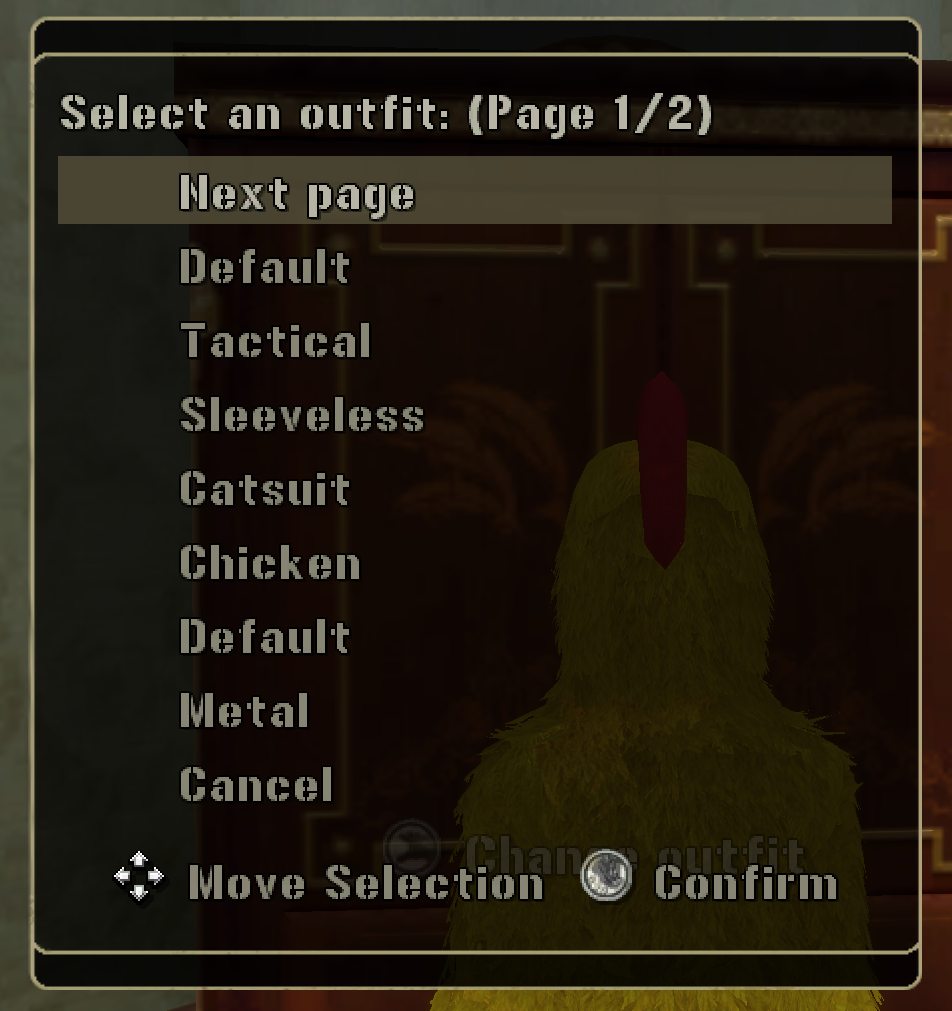
This screenshot predates the expanded NPC roster above — at 40 extra entries plus every hero’s own outfits merged together, the real current menu runs well past the 2 pages shown here.
HijackAutoSuccess.lua — Makes every hijack QTE succeed automatically, with no button presses needed.
The hijack minigame (MrxActionHijack) is entered through one function, OnMinigameStart, which sets up the real input-tracking Event.Minigame listener and (for tap/alternate steps) a simulated-opponent timer that “presses buttons” against the player on its own schedule. Overriding just this one function — same technique as Deep Dive: Overriding a Function — skips creating either of those, forces success immediately, and lets the hijacker’s already-scheduled struggle animation play out normally and complete on its own:
import("MrxActionHijack")
import("MrxGuiHudActionHijack")

MrxActionHijack.OnMinigameStart = function(self)
  local tStep = self[self.nCurrent]
  tStep._buttonPressed = true
  tStep.bSuccess = true
  pcall(MrxGuiHudActionHijack.HideButton, self._hijackerPlayer)
  pcall(Sound.CueSound, 0, "ui_HUD_Minigame_Press_Button")

  -- Multi-round "reactive loop" steps normally finish from inside HandleTapMinigame's own round-scoring
  -- logic, which this override never runs -- so those need to be pushed to completion directly instead.
  if tStep.nReactiveLoop ~= nil and not tStep.bMinigameDone then
    tStep.bMinigameDone = true
    MrxActionHijack.DeleteAllEvents(self)
    MrxActionHijack.DoSuccessAnimation(self)
  end
end
Confirmed working by live testing — animations play out cleanly with no button presses needed, exactly as expected: the ordinary (non-reactive-loop) press/hold/tap/alternate steps look completely normal, since the character still plays out their usual struggle animation at its usual pace — the only difference is that no real input is required (or possible) during it, because bSuccess was already forced true before the QTE prompt would have appeared.
CoopTetherRange.lua — Widens (or removes) how far apart co-op players can wander before getting pulled back together. Unverified — needs a real co-op session to confirm.
The co-op “stay together” mechanic — the boundary that kicks in when the second player wanders too far from the host — is driven by two module-level values, a minimum and a maximum distance, and rebuilding them is done by re-running the same setup function the game itself uses:
import("MrxCoop")

MrxCoop.SetupTether(5, 500)  -- (min, max) -- units and real default values unconfirmed, pick numbers to taste
Everything about the mechanism itself is confirmed from source — SetupTether(aTetherMin, aTetherMax) is a real function, and exceeding the max distance is what actually flips Player.SetOutBoundary(secondaryPlayer, true) for the trailing player. What’s not confirmed: the real default (min, max) values — there are no calls to SetupTether() anywhere in the decompiled corpus, meaning either the real defaults come from native code, or from one of the handful of files that failed to decompile — so this script’s (5, 500) is a placeholder, not a documented default, and the whole thing hasn’t been tested in an actual two-player session yet.
One thing worth knowing if you experiment with this yourself: just reassigning MrxCoop.iTetherMax directly, without calling SetupTether() again, won’t do anything — the proximity watchers that actually enforce the distance are created once via Event.Create(..., iTetherMax, ...), which bakes in whatever value it had at that moment. Only a fresh SetupTether() call tears down the old watchers and rebuilds them against the new numbers.